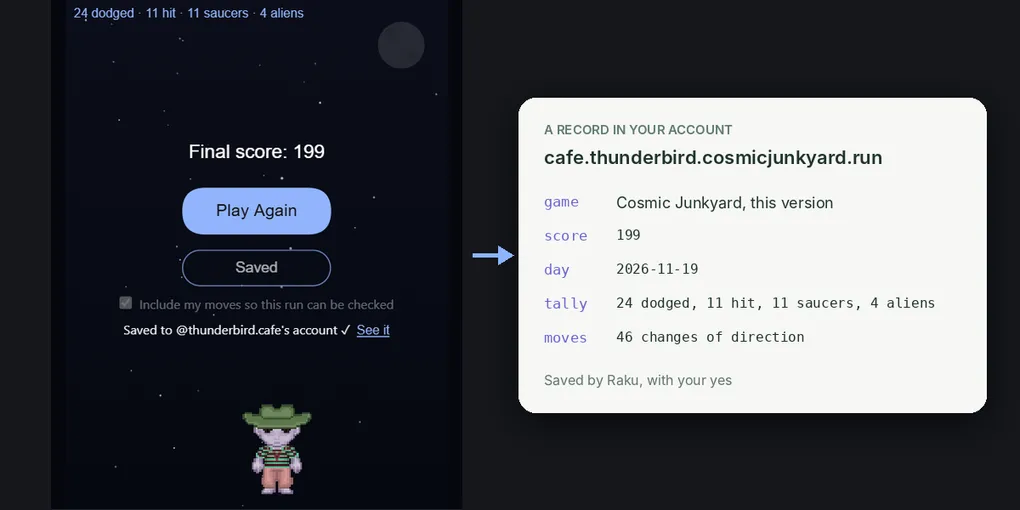
Cosmic Junkyard: a web tile game that makes a record for your account
Cosmic Junkyard got an update. Dice still fall out of the sky, and you still walk left and right to dodge them. But the game now has sounds, it plays as your own rpg.actor character when you’re signed in to Raku, and at the end of a run it can create a record of that run for your account.
The character part is simpler than before. In the first Cosmic Junkyard post, you typed your handle under the game and the page fetched your sprite from your account. In Raku there’s nothing to type: if you’re signed in, Raku finds your character in rpg.actor’s Compendium (one tile that holds every rpg.actor character) and hands it to the game.
Here’s the game. This page’s player shows it, and still offers the handle search, but it doesn’t save runs:
Loading the game…
To save a run, play it in Raku.
A sealed game that hands over its own record
A web tile is sealed: it has no network and no sign-in, and it can’t write anything anywhere. So how does a run end up in your account?
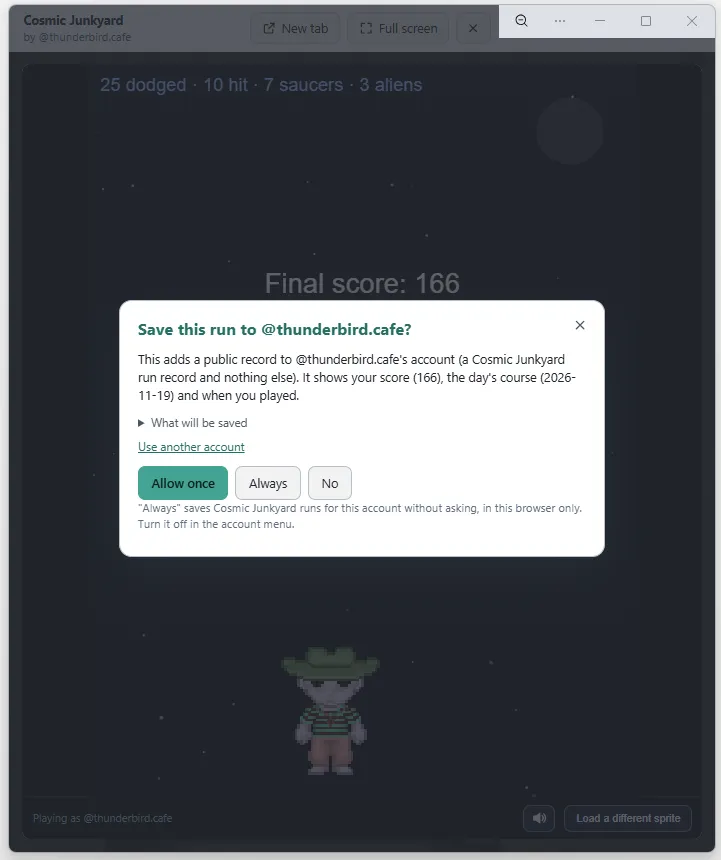
The game makes the record itself. When a run ends and you press Save this run, Cosmic Junkyard puts together a small record (your score, the day’s course, when you played, what you dodged and caught) and hands it to Raku, with the name of the collection it belongs in. Raku then:
- checks that the record really comes from Cosmic Junkyard’s own tile, and that it’s exactly the kind of record that collection holds, field by field;
- adds the two things the game can’t vouch for: which game made it, by its address and exact version, and when it was saved;
- asks you;
- writes it to your account.
That’s new in this series. In Seven-Up, the player’s tile just asked the page to save, and the page built the record itself from the referee tile’s result. The page had to understand Seven-Up. Here the game writes its own record, and Raku only has to know what a valid one looks like.
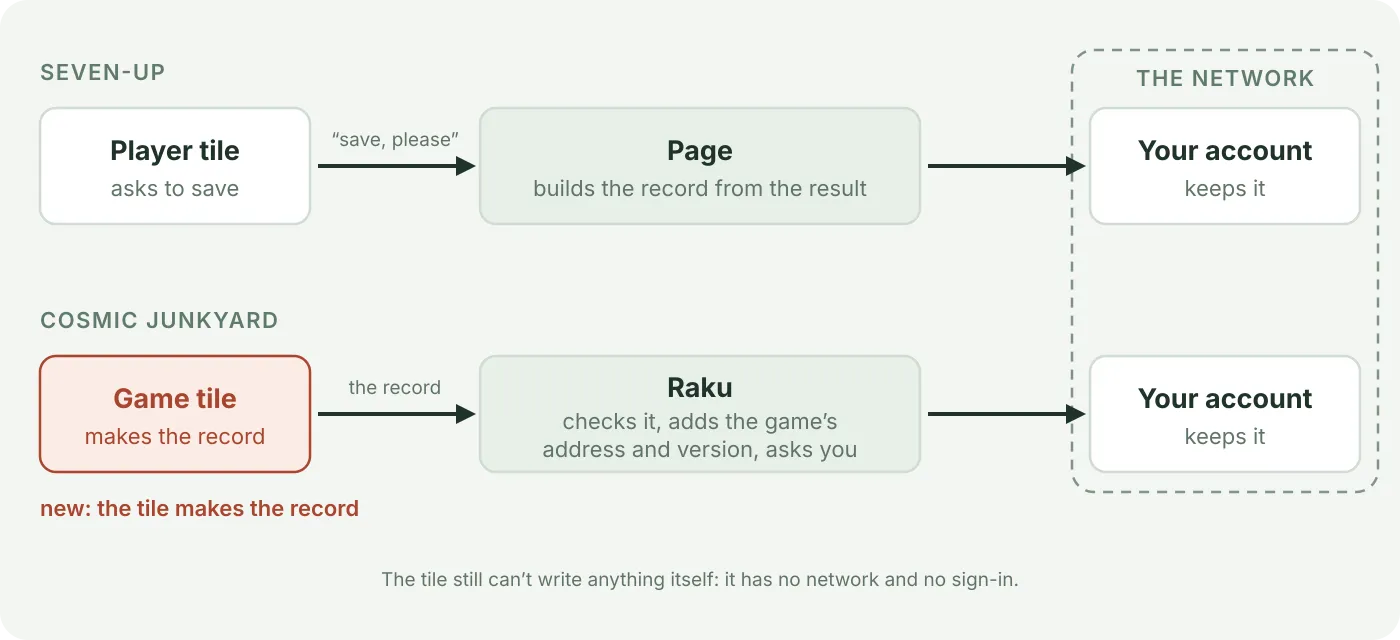
It’s a bit like the difference between asking someone to send in a form for you and handing them the form already filled in. They don’t need to know how to fill it in, only how to check it’s done properly. That’s what lets the same path work for more games: each brings its own kind of record, and the host checks it and delivers it.
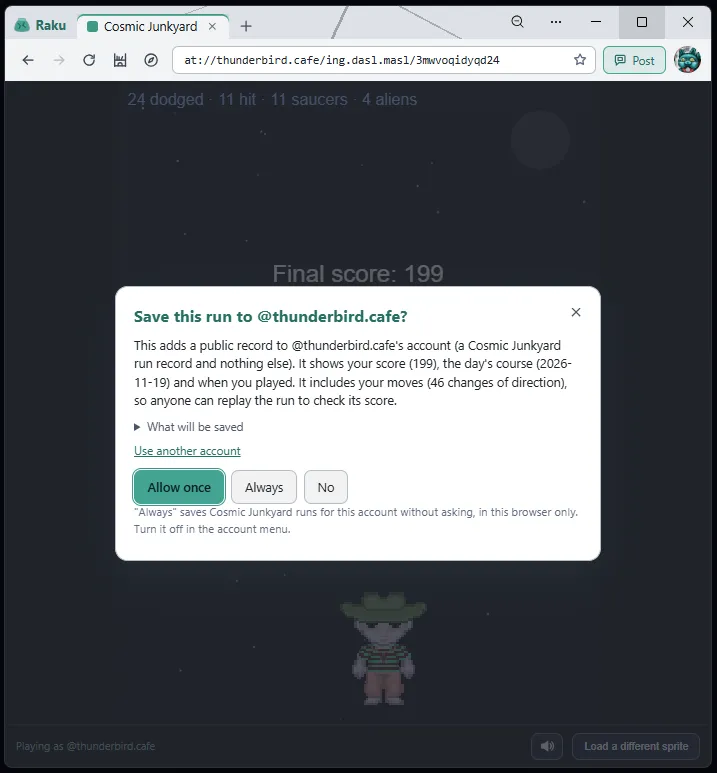
Raku’s prompt says what will be added and offers Allow once, Always (for that account and game, in this browser) or No. The tile never sees your sign-in; Raku does the writing. When it’s done, the game says so:
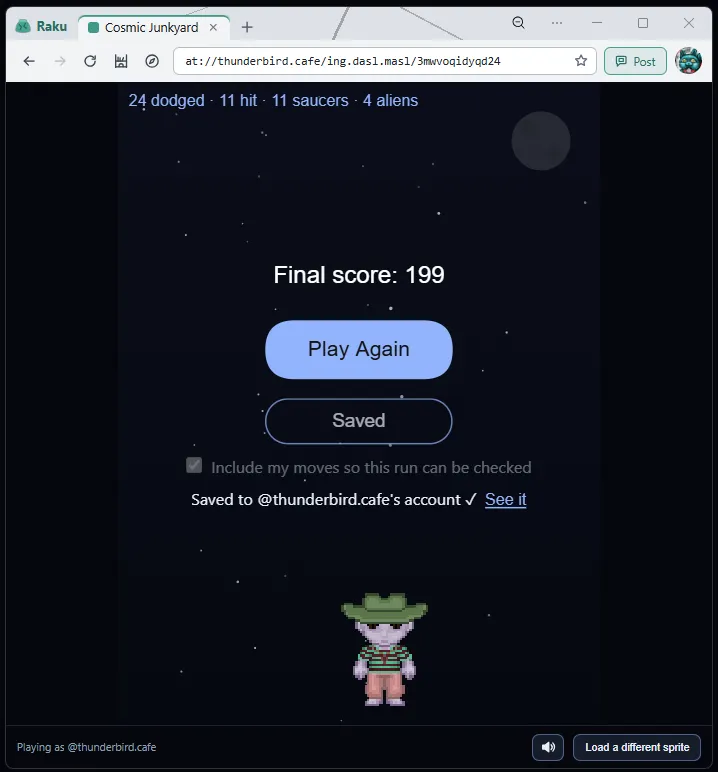
See it opens the record, a cafe.thunderbird.cosmicjunkyard.run in your own repo. Here’s one of mine, in PDSls:
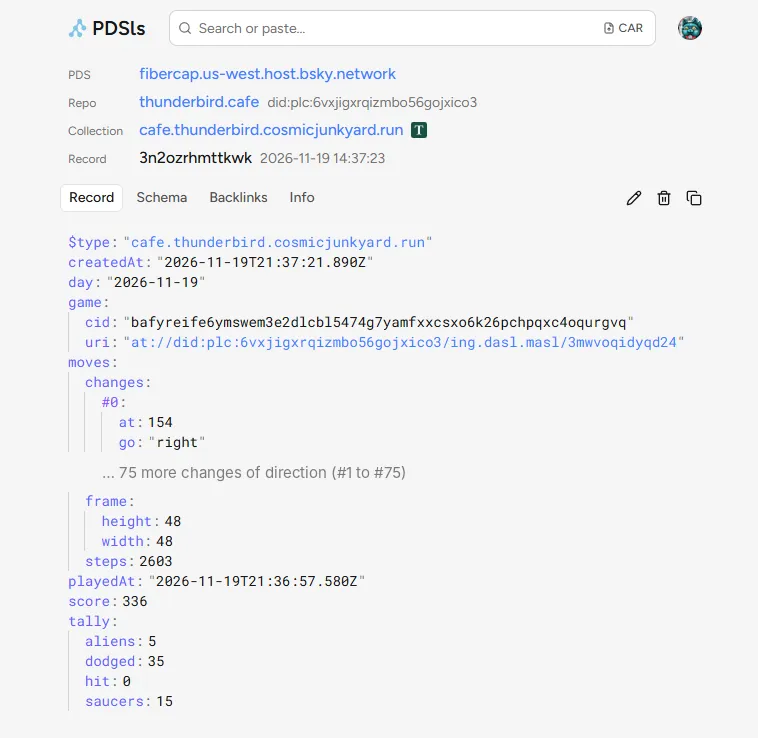
As text:
{
  "$type": "cafe.thunderbird.cosmicjunkyard.run",
  "game": {
    "uri": "at://did:plc:6vxjigxrqizmbo56gojxico3/ing.dasl.masl/3mwvoqidyqd24",
    "cid": "bafyreife6ymswem3e2dlcbl5474g7yamfxxcsxo6k26pchpqxc4oqurgvq"
  },
  "score": 336,
  "day": "2026-11-19",
  "playedAt": "2026-11-19T21:36:57.580Z",
  "tally": { "dodged": 35, "hit": 0, "saucers": 15, "aliens": 5 },
  "moves": {
    "frame": { "width": 48, "height": 48 },
    "steps": 2603,
    "changes": [{ "at": 154, "go": "right" }, { "at": 167, "go": "stop" }, …]
  },
  "createdAt": "2026-11-19T21:37:21.890Z"
}
Runs anyone can check
A score on its own proves nothing: anyone could write a record that says 10,000. So on the save screen there’s a box, Include my moves so this run can be checked, off unless you tick it.
With it ticked, the record also holds your moves: every change of direction, by step (the game runs 60 steps a second), plus the size of your character, which sets how big a target you are. Every player gets the same course on a given day, so those moves, played again on that day’s course, give exactly the same run.
And the record names the exact version of the game that played it. A web tile’s version is its content address, so a replay can run the very same code, not just something with the same name. Anyone can do it with the replay script in the game’s repo:
node scripts/check-run.mjs run.jsonHere’s that run of mine (the 336 above), checked:

A check that passes shows that this score came from these moves, on that day’s course, in that version of the game. So it catches a made-up score, a run claimed for a different day, and a changed copy of the game. What it can’t tell you is who or what pressed the keys: a perfect run played by a program would check out too.
Play right in a tile post
Raku has tile posts: posts that carry a live tile you can play in place. Cosmic Junkyard works there just as it does in its own tab. Press Play here on its post, and you get your character, and Save this run at the end. The game’s end screen is small at post size, so Expand makes it comfortable. Raku’s prompt comes up over the whole window, and from Full screen, Raku steps out of full screen to ask.
Open Tile posts in Raku to find it.
What’s public
Your saved runs live in your own account, and like other records there, they’re public: they show your score and roughly when you played. Ticking “Include my moves” adds the moves themselves, which is what lets anyone replay the run and check the score; leave it unticked and the record holds just your score. Nothing is saved until you press Save.
For game developers
The game’s repo has a README written for you: the messages both ways, the record and its lexicon, the replay script, and how to do the same in your own game.
The messages are small and travel over the Tiles Protocols data channel, the same one the character uses:
- The game says
hello. A host that can save its runs answerscan-save, naming the collection. - Save this run sends
write-record, with an id, the collection and the record. - The host answers with its status (
asking, thensaving) and a result:okwith the record’s address and the account’s handle, or why not (declined,not-allowed,invalid,failed). - See it sends
open-recordwith that address.
A game that hears nothing back simply never shows the save button, so it still works in any other host.
Raku’s rules, as it stands today:
- Only Cosmic Junkyard’s own tile, any version of it, may save into its collection; a copy published somewhere else isn’t told it can save.
- Only new records. Raku keeps only the game’s own fields, checks each one, and fills in
gameandcreatedAtitself. - At most 20 saves per load, one at a time. Signing in to Raku covers saving game runs, along with its other permissions.
One honest caveat: Raku isn’t fully general yet. It keeps a list of the games it accepts, with a copy of each game’s record check. A new game means a new collection, a line in that list, and one more approval when you sign in.
What’s next
More games. Over time, more web tile games will come into Raku much the way Cosmic Junkyard did, each saving its own runs to your account.